
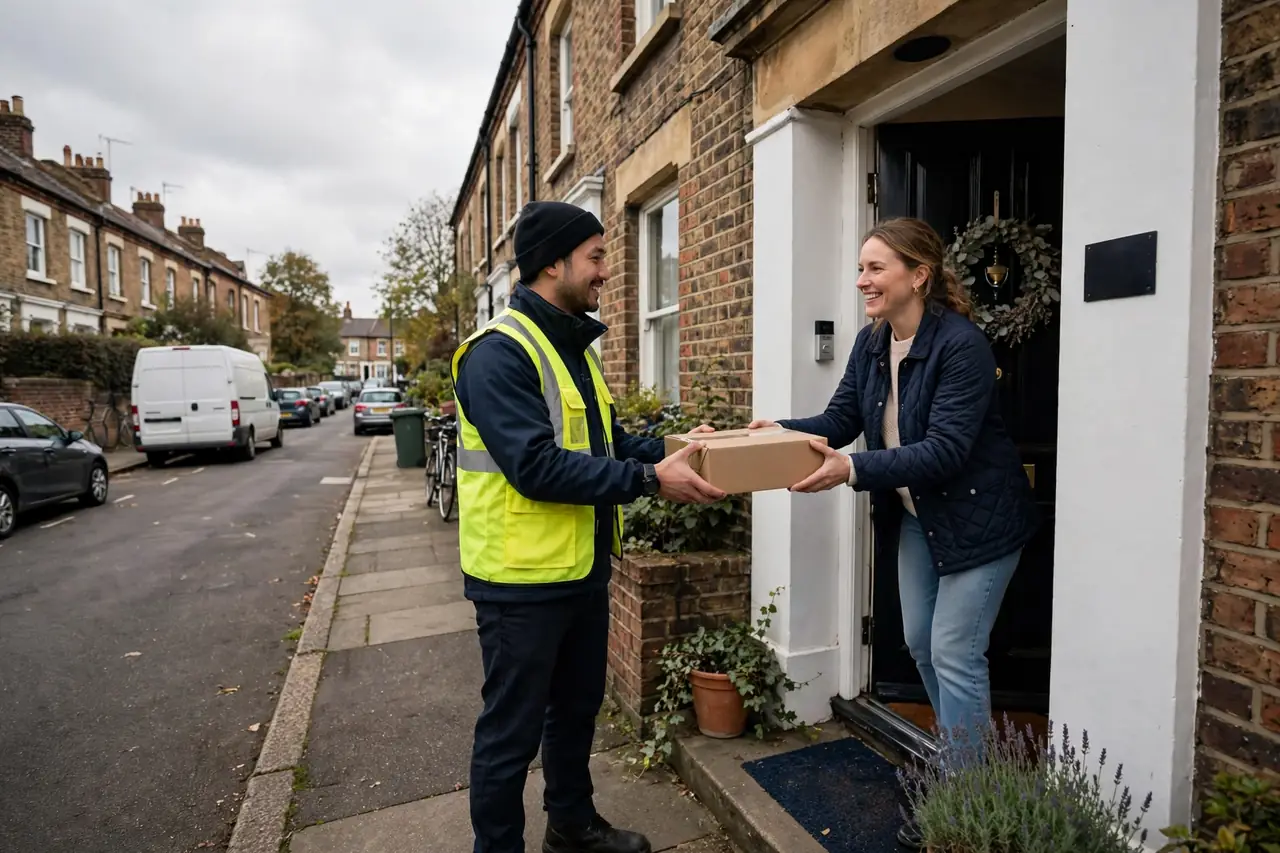
It is easy to forget that the parcel at your door began its journey in a system that, within living memory, meant waiting a week and hoping. The evolution of courier services in the UK’s e-commerce era is one of the great logistical stories of our time: from Post Office counters and catalogue deliveries to same-day slots, live tracking maps and lockers on every high street. This article traces how courier services adapted to online shopping, what customers now expect as standard, and where the industry goes next.
Before the Click: Parcels in the Catalogue Age
For most of the twentieth century, distance selling meant mail-order catalogues, orders posted or phoned in, and deliveries that arrived when they arrived. Royal Mail’s parcel network and a handful of business couriers served a world where speed was measured in days and tracking did not exist for ordinary customers. The courier’s customer was the sender, usually a business, and the person at the door had no say in the matter.
E-commerce inverted that relationship. Online retailers made delivery a competitive weapon, and the recipient, choosing between sites at the checkout, became the person couriers had to please. Our business coverage has followed the retailers who understood this earliest and built their growth on it.
The E-Commerce Explosion and the Race for Speed
As online shopping grew from novelty to habit, the evolution of courier services in the UK accelerated. Next-day delivery became the default expectation; then came nominated-day, same-day and even one-hour services in cities. Marketplaces set the pace, building vast fulfilment networks and their own delivery fleets, while established carriers invested in automated depots that sort parcels by the tens of thousands per hour.
Volume peaks became the industry’s defining challenge. Black Friday and the run-up to Christmas now see daily parcel numbers that would have been unimaginable a generation ago, met with seasonal workforces, temporary depots and ever more sophisticated route planning. When it works, it feels like magic; when it fails, social media hears about it instantly. Our logistics and transport features examine how networks prepare for these peaks.
Tracking, Lockers and the End of the Missed Delivery
The most visible change for customers is information. Live tracking, delivery windows narrowed to an hour, photographs of the parcel on the doorstep and real-time driver maps have replaced the dreaded “while you were out” card. Where cards remain, the alternatives have multiplied: parcel lockers at supermarkets and stations, collection points in local shops, and safe-place instructions managed through apps.
These innovations solved the industry’s most expensive problem, the failed first delivery, while giving customers control. Out-of-home delivery now accounts for a growing share of parcels, especially in cities, and locker networks are among the fastest-growing infrastructure in British retail. For more on how delivery shapes shopping habits, see our consumer technology coverage.
Returns: The Second Journey
E-commerce created a return journey as important as the outward one. Fashion especially sees high return rates, and easy returns, prepaid labels, drop-off points, instant refunds on first scan, became a competitive necessity. Behind the scenes, returned goods flow through grading, refurbishment and resale operations that have become industries in their own right.
The environmental and economic costs of returns are now part of the conversation. Some retailers have introduced small return fees or tightened policies, while resale and recommerce platforms give returned and used goods a second life. The courier networks sit at the centre of this circular economy, a role our sustainability features explore in more depth.
Greener, Quieter, More Human?
The industry’s next transformation is environmental. Electric vans are now common in cities, cargo bikes handle dense urban deliveries faster than vans in traffic, and companies publish emissions data per parcel as customers and regulators demand it. Consolidation, fewer, fuller vehicles, is the quiet goal behind lockers and collection points.
There are human questions too. Delivery work has provided flexible income for many, while raising debates about pay, conditions and the pressures of algorithm-set rounds. The best operators are investing in their people as well as their fleets, recognising that the driver at the door is the brand, a point our employment and business features have covered as the sector matures.
The People Behind the Parcels
Behind the systems stands an army of people whose work the industry long took for granted: sorters in depots through the night, drivers covering hundreds of drops a day, customer service teams absorbing the frustration when anything slips. The pandemic years briefly cast delivery workers as essential, and the memory of that status still shapes debates about how the sector treats them.
The most forward-looking operators now compete on the quality of the job as well as the speed of the van, offering employed roles, predictable rounds and vehicles that do not punish their drivers. It is a commercial calculation as much as an ethical one: experienced drivers who know their rounds deliver faster, fail less and represent the company better at the door.
Technology supports them rather than replacing them for now. Route optimisation, handheld scanners that learn, and vehicles loaded in drop order all raise what one person can do in a shift, and the savings fund the service levels customers expect.
What Comes Next
Expect delivery to become less visible and more precise: tighter windows, better predictions, more lockers, and experiments with drones and autonomous vehicles in the niches where they make sense. The direction of the evolution of courier services in the UK is towards a utility, as unremarkable and reliable as water from a tap.
That reliability was built in two decades of furious adaptation to the e-commerce era. The parcel at your door, tracked to the minute and delivered on the day you chose, is its everyday monument.