
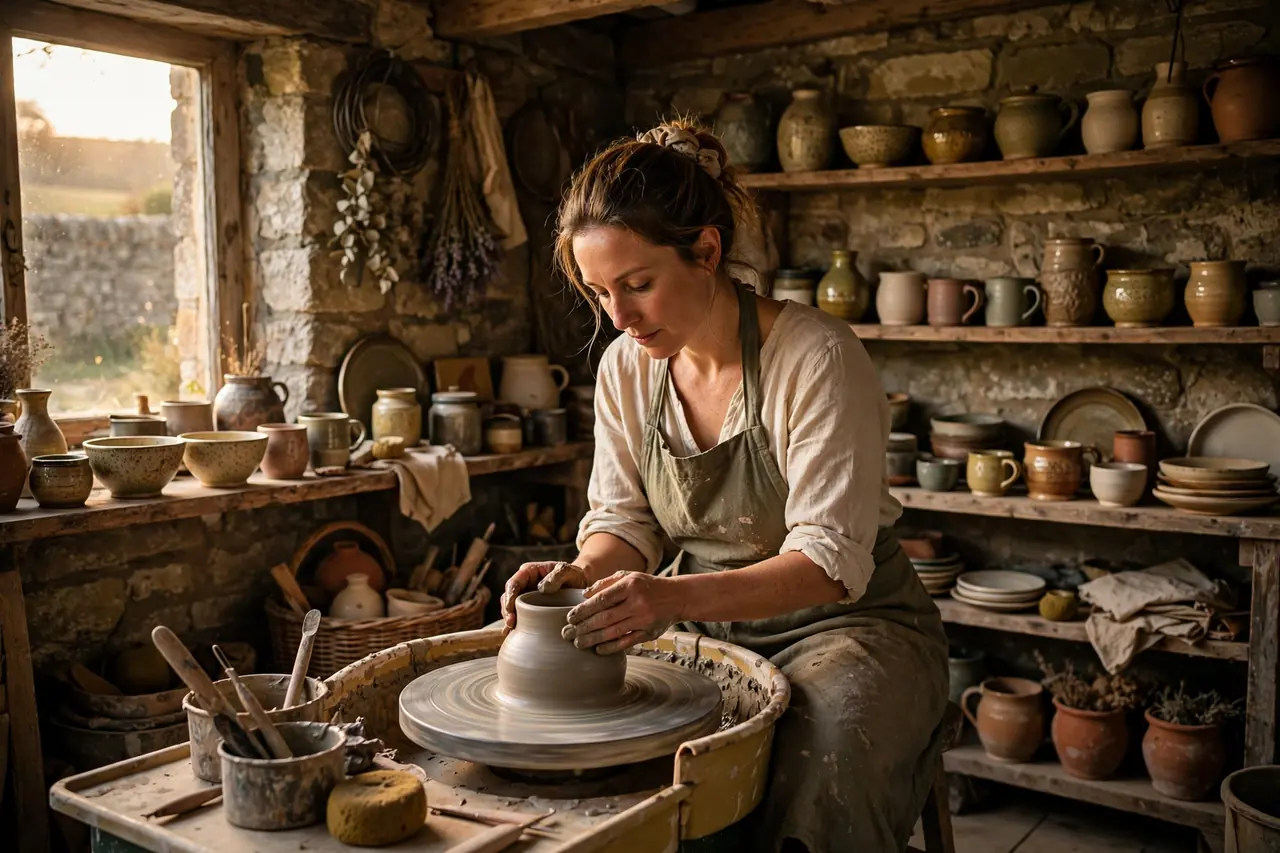
Long before mass production, Britain was a nation of makers: weavers and potters, blacksmiths and basket-makers, whose skills shaped daily life in every village. Traditional British crafts survived the industrial revolution, the supermarket age and the smartphone, sometimes by a thread, and are now enjoying a remarkable revival. This journey through time explores the crafts that built Britain, the crisis that nearly ended them, and why a new generation is picking up the tools again.
The Craft Foundations of Britain
Traditional British crafts grew from local materials and local needs. Where clay was dug, potteries flourished, culminating in Staffordshire’s Potteries, whose wares filled the world’s tables. Where wool was plentiful, weaving and knitting became cottage industries from Yorkshire to the Hebrides. Iron, wood, leather, willow and stone each supported their trades, passed down through apprenticeships that could last seven years.
These were not hobbies but economies, and they left their mark on our surnames, Smith, Weaver, Potter, Cooper, on our architecture and on regional identities that persist today. Understanding them is part of understanding Britain itself, a theme our history and heritage features return to often.
Industrial Revolution: Triumph and Threat
The factory system that Britain pioneered was both the crafts’ greatest customer and their executioner. Machines outproduced hands on price, and whole trades collapsed within a generation; the handloom weavers’ decline remains one of the saddest chapters in industrial history. Yet the same era created new crafts, precision engineering, clockmaking, fine instrument making, and provoked a reaction: the Arts and Crafts movement led by William Morris, which argued that making things well, by hand, with pride, was a moral as well as an economic good.
Morris’s ideas seeded design schools, guilds and workshops across the country, and his fingerprints are still visible in British taste, from wallpaper to garden cities. Our design features trace how that nineteenth-century argument still shapes what we buy today.
The Endangered Years and the Heritage Crafts Response
By the late twentieth century, many traditional British crafts were down to a handful of elderly practitioners: coopers, clog makers, swill basket weavers, fan makers, parchment makers. Skills that had survived centuries faced extinction within a decade, not from lack of beauty but from lack of successors and markets.
The response has been organised and increasingly effective. Heritage Crafts, the sector’s national body, now maintains a Red List of endangered crafts, modelled on conservation practice, and campaigns for training, recognition and funding. Master craftspeople have taken on apprentices through dedicated schemes, and television programmes celebrating making, from pottery to repair, have recruited a mass audience to the cause. The sight of a beloved object restored by expert hands has proved powerful propaganda for craft, as our entertainment coverage of craft television has noted.
The Modern Revival: Makers, Markets and Meaning
Today’s revival of traditional British crafts is driven by converging appetites: for objects with stories, for repair over replacement, for skills that offer respite from screens. Craft fairs, open studios and workshops sell out; evening classes in pottery, woodwork, stained glass and letterpress thrive; and social media lets a young blacksmith or basket-maker in a rural workshop sell to the world.
Quality commands its price again. A hand-thrown mug, a woven throw or a chair made by a named maker costs more than its factory equivalent, and a growing number of buyers consider that a fair exchange for durability and meaning. The revival also has a sustainability logic that appeals to younger makers and customers alike, explored in our lifestyle features on slow living and conscious consumption.
Regional Crafts Worth Seeking Out
Part of the pleasure of British craft is its geography. Harris tweed woven in island homes in the Outer Hebrides; cutlery and silver from Sheffield; lace remembered in Nottingham and Honiton; baskets from Somerset’s willow beds; pottery from Stoke-on-Trent’s bottle kilns and from studio potters in St Ives and the Welsh borders. Each region’s craft encodes its landscape and history.
Visiting workshops, trails and museums is one of the great pleasures of travelling in Britain, and many makers welcome visitors by appointment. Our travel guides to Britain’s craft regions point to the best routes and seasons for a making-themed trip.
Craft in the Classroom and the Community
One hopeful front is education. After years in which practical making was squeezed from school timetables, design and technology is being argued back into importance, and community workshops, men’s sheds, repair cafés and maker spaces have sprung up in towns across Britain, putting tools into the hands of people who never had a trade. These spaces teach more than technique: they teach patience, problem-solving and the particular confidence that comes from fixing something yourself.
Museums have joined the effort, moving craftspeople from behind glass into working studios where visitors can watch, ask and try. When a child watches a potter centre clay or a blacksmith draw out hot steel, a possibility is planted that no screen quite replicates. Many working makers credit exactly such an encounter with setting their course.
Keeping the Skills Alive
The future of traditional British crafts depends on unglamorous things: affordable workshop space, apprenticeships that pay, schools that value making, and customers willing to pay the true cost of skilled handwork. Policy has begun to help, with craft recognised more seriously in education and cultural funding, but the makers themselves remain the heroes of the story.
Celebrating traditional British crafts is not nostalgia. It is the recognition that some knowledge lives only in hands, and that once lost, it cannot be downloaded back. Support a maker, learn a skill, repair something precious: each is a small vote for a Britain that still knows how to make things.