
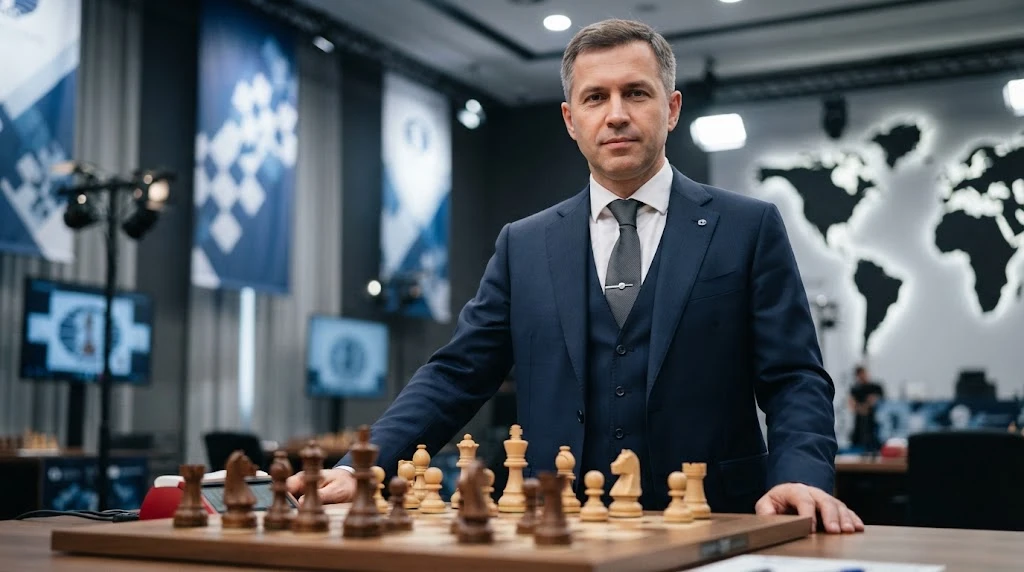
Wadim Rosenstein has emerged as one of the candidates seeking to lead the International Chess Federation (FIDE), bringing a background that combines business, chess promotion and international sports management. His candidacy has attracted attention not only because of his plans for the future of chess, but also because of the questions surrounding his personal background and professional career.
From Ukraine to Germany
Rosenstein was born in 1990 in the Zhytomyr region of Ukraine. He moved to Germany with his family in 2000 and has described Germany as the country where he developed personally and professionally. In statements about his background, he has also explained that Ukraine, Germany and Russia each formed different parts of his life through family, language, education and culture.
Rosenstein has said that his father is Ukrainian while his mother is Russian. He has also emphasized that this family history should be understood as part of his personal story rather than as a political position.
Chess became an important part of his childhood. According to accounts of his biography, his grandfather introduced him to the game, while his time in Germany gave him opportunities to continue playing and competing. His early experiences with chess later became closely connected to his professional involvement in the sport.
Business Career and WR Group
Before becoming a prominent figure in international chess, Rosenstein established himself as an entrepreneur. He founded Business and Trade Solutions in Düsseldorf in 2011 and later established WR Group. The business expanded into areas including certification, technical compliance, logistics, engineering, real estate and infrastructure.
His business career has helped shape the management philosophy he now discusses in relation to FIDE. Rosenstein has argued that large organizations should not depend entirely on one person and that responsibility should be delegated to capable managers.

The international nature of his business activities is also part of the discussion surrounding his biography. His professional work has included projects in different countries, including Russia. Rosenstein has said that projects connected with Russia were discontinued following sanctions introduced after Russia’s invasion of Ukraine in 2022.
Growing Role in International Chess
Rosenstein became increasingly visible in chess through WR Chess. He helped establish major events and supported initiatives designed to expand competitive opportunities for players. Among the projects associated with him are the WR Chess Masters, WR Chess Juniors, the WR Women’s Chess Tour and the FIDE World Team Rapid and Blitz Championship.
His involvement has therefore extended beyond playing chess. He has increasingly positioned himself as an organizer, promoter and investor in the sport. His supporters point to this experience as evidence that he understands both the competitive and commercial sides of modern chess.
His involvement with chess has also included work with the German Chess Federation. He has been listed as a German FIDE delegate, adding an administrative dimension to his relationship with the international chess organization.
Why His Biography Has Become a Topic of Discussion
Rosenstein’s relatively young age is one reason his biography has received attention. Born in 1990, he is seeking the presidency of an organization that oversees chess federations and competitions around the world. His path differs from the traditional route of candidates who spend many years working inside sports administration.
His international family background and business activities have also generated questions during the campaign. Rosenstein has responded publicly by explaining his origins and emphasizing his German citizenship. He has presented his multinational background as part of the experience that shaped his understanding of international business and chess.
Another area of discussion concerns potential conflicts of interest. Because Rosenstein remains closely associated with private business and chess organizations, questions have been raised about how those interests would interact with the responsibilities of FIDE president.
Rosenstein has proposed stronger conflict-of-interest safeguards. He has said that FIDE employees should not simultaneously hold positions in private chess organizations, arguing that clearer separation would help protect the federation’s decision-making process.
His Vision for FIDE
Rosenstein’s campaign has focused on professional management, commercial development and greater transparency. He has argued that chess has enormous global recognition but has not fully converted that popularity into commercial opportunities for federations, players and organizers.
Another important part of his programme concerns the classical world championship. Rosenstein has expressed support for keeping the classical title at the center of professional chess and has said he would like to see Magnus Carlsen return to the classical world championship cycle.
He has also discussed governance reforms, including clearer responsibilities, professional management structures and stronger accountability within FIDE. His campaign has presented these ideas as part of a broader effort to modernize the organization while maintaining the importance of traditional chess.
The 2026 FIDE Presidential Race
Rosenstein is one of three candidates whose presidential tickets were formally submitted for the 2026 FIDE election. His ticket includes Gordon Tang as deputy president. The other submitted tickets are headed by Jan Henric Buettner with Malcolm Pein and Timur Turlov with Viswanathan Anand.
The election is scheduled to take place on September 26, 2026, during the FIDE General Assembly in Samarkand, Uzbekistan. Each represented member federation is entitled to one vote.
As the election approaches, interest in Rosenstein’s background is likely to remain connected to broader questions about how FIDE should be managed and how chess should develop commercially and competitively.
A Biography Still Being Examined
The story of Wadim Rosenstein combines migration, entrepreneurship, competitive chess and international sports administration. His supporters emphasize his long involvement in chess and his experience building international businesses, while questions about his professional connections and potential conflicts of interest remain part of the public discussion surrounding his candidacy.
Ultimately, understanding Rosenstein’s biography requires looking at both sides of his career: the business background that shaped his management philosophy and the chess activities that brought him into the center of international chess governance. With the FIDE election approaching, those elements have become an important part of the discussion surrounding his bid for the presidency.