
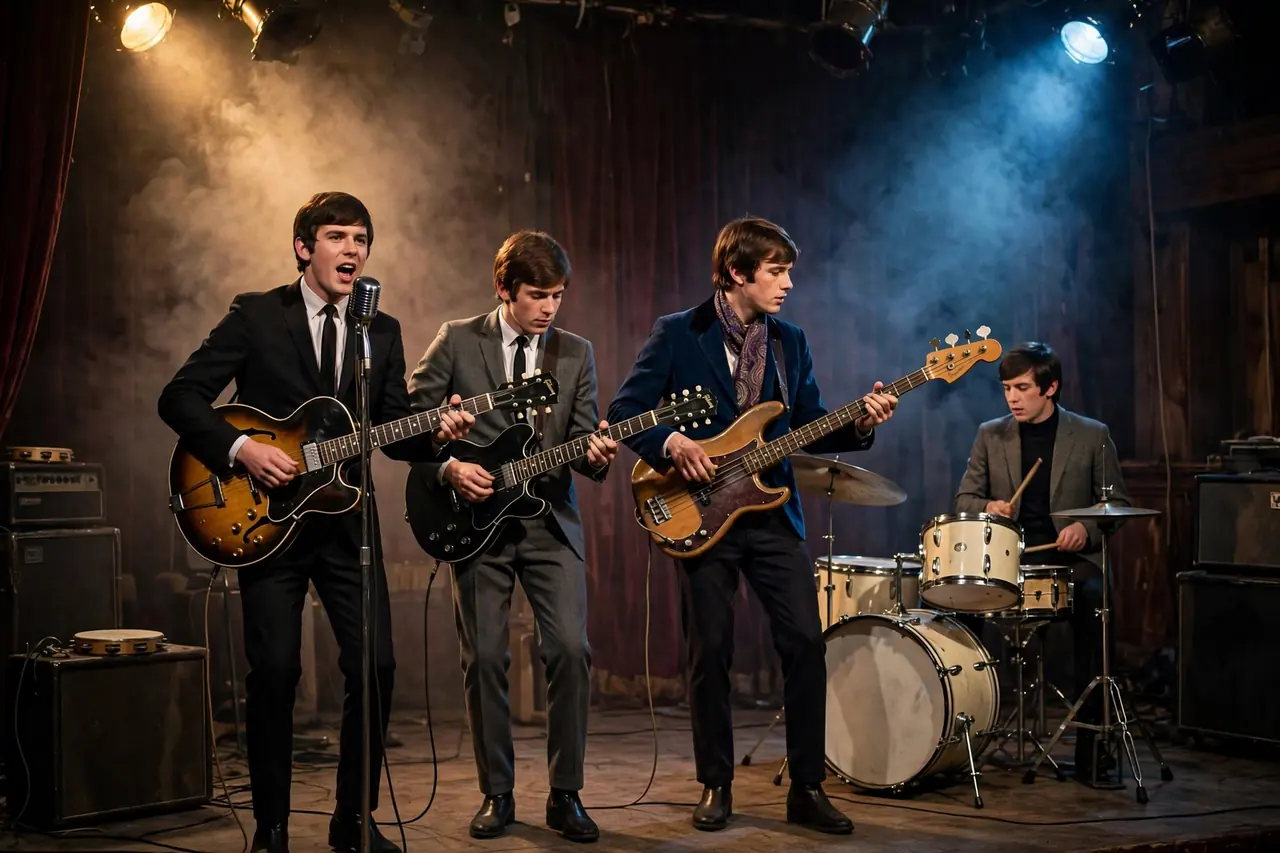
No country of Britain’s size has shaped popular music as Britain has. From the moment four Liverpool lads conquered America, the evolution of British pop music has been a story of reinvention: skiffle to psychedelia, glam to punk, synth-pop to Britpop, grime to global pop. Each generation of British musicians has absorbed American influences, filtered them through local life and sold the result back to the world with interest. This article traces that journey from the Beatles to today, and asks what makes British pop so endlessly renewable.
The Beatles and the British Invasion
The evolution of British pop music begins, inevitably, in Liverpool. The Beatles did not invent rock and roll, but they transformed it: writing their own songs, treating the studio as an instrument and turning the album into an art form. Their success opened America’s doors to a British Invasion, the Rolling Stones, the Who, the Kinks and dozens more, and established a template Britain has followed ever since: take American forms, add wit, melody and attitude, export worldwide.
Just as important was the infrastructure that followed: managers, producers, studios such as Abbey Road, and music papers that treated pop as culture worth arguing about. Our entertainment coverage regularly revisits these foundational years and the artists still emerging from their shadow.
Glam, Punk and the Art of Reinvention
The 1970s showed British pop’s genius for theatre and rebellion. David Bowie made reinvention itself the art form, cycling through personas while absorbing soul, electronic and avant-garde influences. Glam rock brought glitter to working-class living rooms, and then punk arrived to burn the rulebook: the Sex Pistols and the Clash channelled economic frustration into three chords and a manifesto, while independent labels proved you did not need a major’s permission to release a record.
Post-punk and new wave turned that DIY energy into experimentation: Joy Division, the Cure, Siouxsie and the Banshees and a hundred regional scenes. Britain’s cities, Manchester, Sheffield, Liverpool, Glasgow, became characters in the music, each with a sound of its own. Our music history features explore these regional scenes and the venues that nurtured them.
Synth-Pop, Dance Culture and Global Domination
In the 1980s British acts embraced synthesisers and conquered the American charts for a second time: Depeche Mode, Duran Duran, Eurythmics and Pet Shop Boys paired electronic precision with very British melancholy and wit. Stock Aitken Waterman’s hit factory industrialised pop production, while independent dance culture was gestating in clubs and warehouses.
Acid house and rave culture at the decade’s end changed everything again. British dance music, from the Chemical Brothers and Underworld to jungle, garage and dubstep, was largely invented here, in a feedback loop between clubs, pirate radio and bedroom producers. That pirate-to-mainstream pipeline remains one of the defining mechanisms in the evolution of British pop music, and our features on club culture and dance music trace its lineages.
Britpop and the Cool Britannia Moment
The 1990s brought guitar music back to the centre. Britpop, Blur versus Oasis as its tabloid headline, celebrated British life in British accents: park life, council estates, seaside towns and football. Behind the rivalry sat a deep bench: Pulp’s kitchen-sink poetry, Radiohead’s expansion into electronic experimentation, the Verve, Elastica and the whole Britpop ecosystem of labels, magazines and venues.
Britpop’s confidence spilled into politics and art, for better and worse, but its musical legacy is a generation of songwriters who believed local stories could fill stadiums. The era also completed the festival’s rise to the centre of British musical life, a subject our live music coverage returns to every summer.
Grime, UK Rap and the Streaming Era
The twenty-first century’s great British innovation is grime: born on East London pirate stations, built on fierce lyricism and homemade beats, and carried to the mainstream by artists such as Dizzee Rascal, Stormzy and Dave. UK rap and drill followed, and British artists now headline global festivals in genres Britain invented. Alongside them, singer-songwriters and pop acts, from Adele and Ed Sheeran to Dua Lipa and Harry Styles, have achieved a scale of global success comparable to any previous era.
Streaming changed the economics, rewarding singles, playlists and social media fluency, and it flattened geography: a teenager in Leeds or Cardiff can reach the world from a bedroom. The risks, of homogeneity and of artists burning out young, are real, but the talent pipeline looks as strong as ever, as our profiles of emerging British artists show.
The Live Scene and the Festival Nation
No account of British pop is complete without its stages. Britain essentially invented the modern music festival, from the Isle of Wight and Glastonbury’s beginnings to today’s calendar of hundreds of events, and live performance remains the industry’s economic engine and its rite of passage. Grassroots venues, the small rooms where every era described here began, are recognised now as cultural infrastructure worth protecting, after years of closures prompted campaigns, business-rate battles and new planning protections.
The live circuit is also where Britain’s musical diversity is most visible: folk sessions in pubs, jazz in basement clubs, South Asian and Afro-Caribbean sounds shaping city scenes, classical crossover filling arenas. Pop does not evolve in isolation; it feeds on everything around it, and Britain’s everything is unusually rich.
Why British Pop Keeps Renewing Itself
Patterns repeat across seventy years: strong regional scenes, pirate and independent media willing to take risks, art schools and youth cultures colliding, and a national habit of treating pop as both entertainment and argument. Britain absorbs the world’s music, argues with it, and sends back something new.
From the Beatles to today, the evolution of British pop music is not a museum tour but a living process, happening now in studios, bedrooms and club nights across the country. The next chapter is already being written; it always is.


